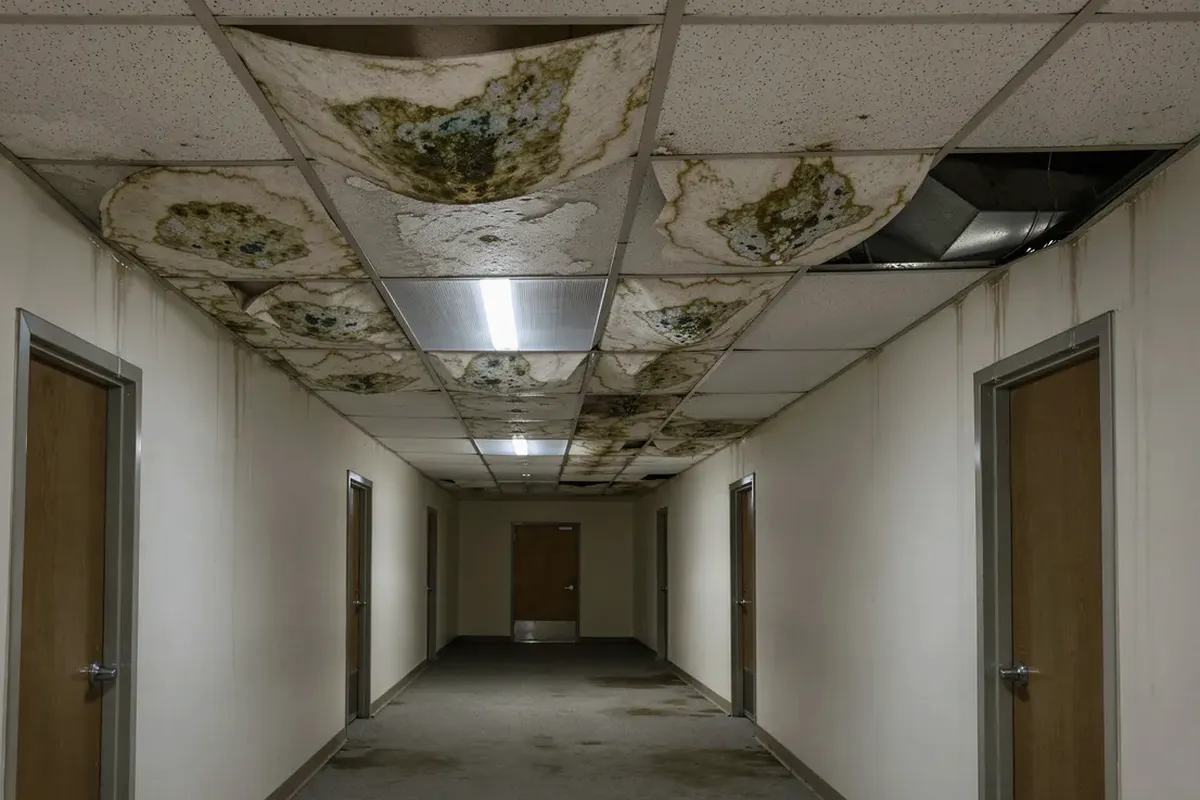
In an office, shop or restaurant the question is how to deal with mold while people keep working nearby. Companies plan around it with off-hours scheduling, plastic containment and air filtration. Call the number on this page to be connected with a local mold company in Grand Prairie.

Questions staff may ask
Employees, members and parents may ask whether a space is fine to use. The honest answer is that moisture readings and a clear scope guide the decision. Anyone with health concerns should talk with their doctor, and managers should keep a written record of what was found.
Old buildings and recent remodels
Older commercial buildings often have patched roofs and aging plumbing, while freshly remodeled space can hide wet framing sealed under new finishes. In both cases, a moisture check before further work protects the investment and shows what the walls and ceilings are really holding.
Buildings near the lake shore or creek bottoms around Grand Prairie sit in damper air, and low ground-floor units can take on water during heavy storms, so drainage and AC performance matter more.
Local details for Grand Prairie
The state draws its line at 25 contiguous square feet: above that, the assessor and the remediator both need a TDLR mold license. TDLR's online search shows whether a license is current.
Texas generally doesn't let the same company assess and remediate the same project, so the protocol, the cleanup and the clearance check come from different businesses.
Grand Prairie's Building Inspections Division handles building permits here, so that's the place to check before walls, cabinets or flooring go back in.
If storm runoff or creek water got inside, FEMA's flood map service and your insurer can tell you how the address is zoned.
Companies that take calls here usually also work in Arlington, Duncanville and Euless.
Separate costs people forget
The assessor's protocol and the final clearance check usually come from a different company than the remediator, and the repair of the leak is a third item. Facility managers who budget for only the removal are often surprised. Ask for each piece to be named.
How a commercial job usually runs
- An assessor holding a TDLR mold license inspects and writes the protocol.
- A separate remediator reviews it and sets a work plan.
- The area is contained, affected materials removed and surfaces cleaned.
- The space is dried and the source repaired.
- A post-remediation assessment confirms the result.
Each step has a different owner, so ask who is responsible for which.
Drying clock
EPA advises drying wet materials within 24 to 48 hours. In a business, that window is easy to miss on a long weekend or after a holiday. If water got in and the space is still damp, treat the situation as urgent and have the area looked at promptly.
Around Grand Prairie
Calls come in from across Grand Prairie, including around Downtown Grand Prairie, Dalworth Park, Lynn Creek Park.
Joe Pool Lake, Mountain Creek Lake and the West Fork Trinity River floodplain are all large floodplain areas within or beside Grand Prairie.
Commercial Mold Remediation questions in Grand Prairie
Can my business stay open during mold work?
Who pays when a tenant reports mold?
Should I test the air in my building?
Do waterfront or low-lying businesses face extra risk?
More mold services in Grand Prairie
Commercial Mold Remediation nearby
Helpful guides
Sources
Last updated: